
Views: 0 Author: Site Editor Publish Time: 2026-07-08 Origin: Site


Routine maintenance of underground infrastructure often incurs hidden operational costs and safety liabilities due to the physical demands of removing heavy, traditional solid access coverings. Field crews waste valuable hours wrestling with 200-pound iron discs just to drop a sensor, pull a water sample, or check a valve. This physical strain leads to fatigue, increased injury rates, and slower route completion times across municipal and private networks. Facilities requiring high-frequency access for sampling, monitoring, or minor adjustments face a direct conflict between maintaining mandatory load-bearing surface integrity and ensuring rapid, ergonomically safe access for personnel. A center access manhole cover resolves this conflict through a dual-lid architecture. This guide evaluates the technical specifications, operational trade-offs, and return on investment factors necessary to determine if a center access design is the right specification for your infrastructure project.
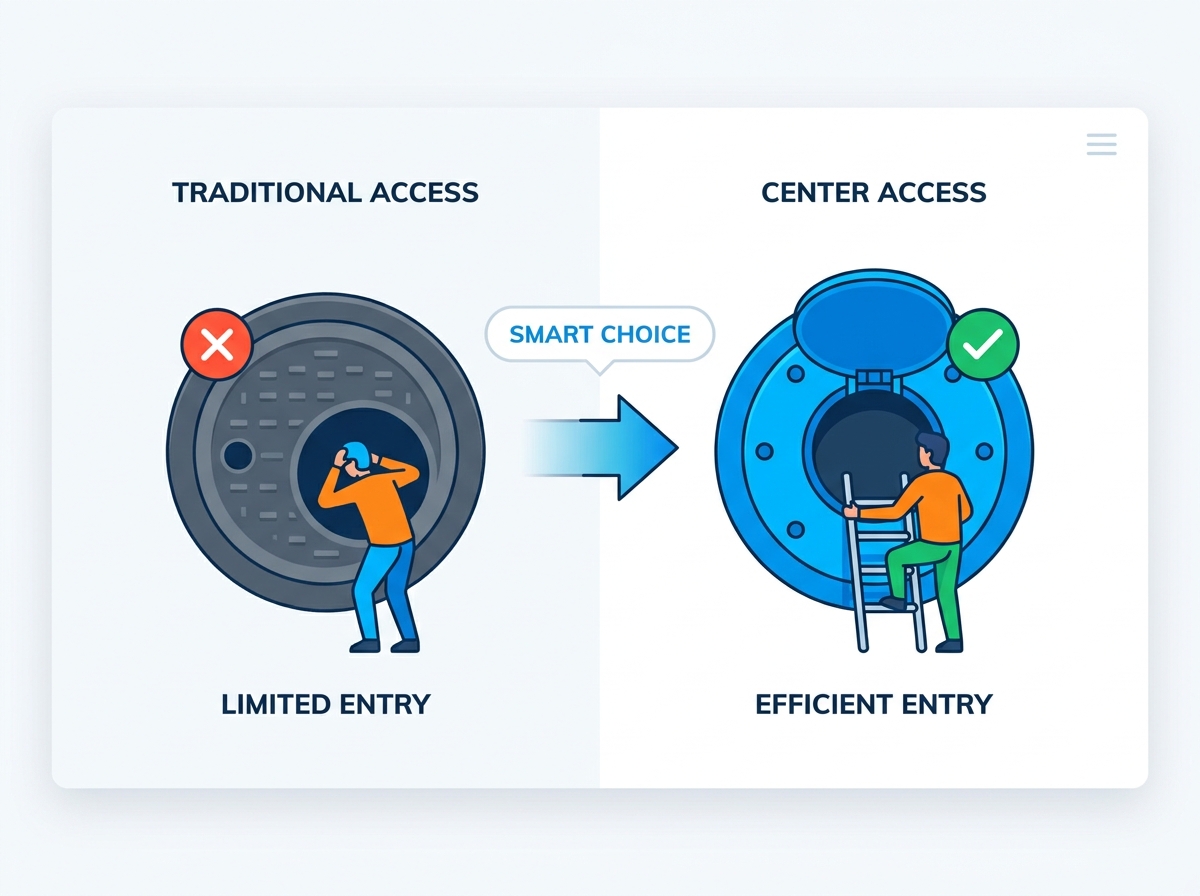
The core concept relies on a concentric design engineered to distribute heavy dynamic loads while providing a localized access point. A heavy-duty outer ring seats directly into the primary frame, providing the necessary structural support to handle vehicular or pedestrian loads. Inside this outer ring sits a smaller, removable center lid. This configuration allows operators to bypass the heavy outer ring entirely for routine tasks, interacting only with the lightweight inner hatch.
Traditional primary covers are round for a specific engineering reason: a round cover cannot fall through its own circular opening, regardless of how it is rotated or angled during removal. It also allows field crews to roll the heavy casting rather than carry it across the pavement. A dual-lid design integrates this logic while solving the weight problem. The inner hatch geometry varies based on the manufacturer and the specific application. Round inner hatches maintain the impossibility of falling into the vault. Square or rectangular inner hatches utilize specialized inner lip supports, engineered shelves, or flanged edges to prevent the smaller lid from dropping into the accessway and damaging equipment below.
Machining tolerances play a massive role in the success of this architecture. The interface between the outer ring and the inner hatch must be milled to exact specifications to prevent rattling under traffic loads. If the seating surface is uneven, the continuous impact of vehicle tires will cause the inner lid to bounce, leading to accelerated wear, noise complaints, and eventual structural failure of the casting.
Certain utility environments demand repeated access without requiring full personnel entry. The dual-lid architecture excels in these specific applications where dropping tools or hoses is the primary objective.
| Infrastructure Type | Primary Task | Equipment Inserted | Access Frequency |
|---|---|---|---|
| Wastewater Management | Effluent sampling and flow monitoring | Sampling bailers, flow meters, sensors | Daily to Weekly |
| Fuel Stations | Inventory checks and vapor recovery | Dipsticks, vapor probes, pump nozzles | Daily |
| Telecommunications | Cable routing and visual inspection | Fiber optic snakes, ventilation hoses | Monthly |
| Stormwater Systems | Grit level checks and water quality testing | CCTV crawlers, sediment depth gauges | Post-Rain Event |
Municipal wastewater crews frequently perform effluent sampling, flow monitoring, and visual inspections to ensure compliance with environmental discharge permits. A smaller access point allows rapid deployment of sampling buckets or sensor drops without exposing the crew to open-hole fall hazards. Forecourt operators at fuel stations require daily access for dipstick measuring, vapor recovery checks, and pump maintenance. Telecommunications technicians use the center opening for temporary cable routing, ventilation hose insertion, and rapid visual inspections of splice enclosures without needing to secure a massive perimeter.
Solid municipal castings often exceed 150 to 250 pounds depending on their load rating and material thickness. Lifting these covers requires specialized leverage tools, magnetic lifters, and places immense strain on the lower back, shoulders, and knees. Conversely, the inner lid of a dual-lid system typically weighs between 30 and 50 pounds. This weight reduction drastically alters the physical requirements of infrastructure maintenance, turning a heavy-duty physical task into a simple, single-handed operation.
The traditional operational debate centers on rolling versus lifting. Heavy round covers are designed to be rolled. However, maneuvering a 200-pound iron disc across uneven asphalt, gravel shoulders, or sloped concrete still presents severe pinch hazards and strain risks. A lightweight inner hatch eliminates the physical strain of both dragging and rolling. Operators can safely lift the center section using standard hand tools like a J-hook or a pry bar. This directly impacts OSHA compliance efforts and helps reduce musculoskeletal disorder claims among maintenance crews, keeping experienced personnel in the field rather than on medical leave.
Time-motion evaluations consistently favor dual-lid systems for specific tasks. Single-operator access becomes the standard operating procedure. Removing a solid cover often requires a two-person team or machinery assistance, such as a truck-mounted hoist. The inner hatch allows a single technician to park their vehicle, open the vault, perform the task, and secure the site in a fraction of the time.
To understand the efficiency gain, consider the standard workflow for atmospheric testing prior to confined space entry:
This rapid access facilitates critical safety protocols without slowing down the crew. Technicians can easily perform non-entry visual inspections using flashlights or pole-mounted cameras, gathering necessary data without ever breaching the plane of the manhole.
Open manholes present severe fall hazards in high-traffic urban areas, active roadways, and crowded pedestrian zones. Keeping the primary outer cover sealed protects pedestrians, cyclists, and vehicles from catastrophic accidents. The center access point provides a restricted opening just large enough for the required task, physically preventing a person from falling into the vault.
Crews frequently use the center opening for temporary routing of suction hoses from vacuum trucks, ventilation tubes, or monitoring cables. This practice significantly reduces the exposed open-hole fall hazard area during active maintenance. A smaller hole requires less complex barricading, minimizes disruption to surrounding foot traffic, and reduces the liability footprint for the municipality or contractor performing the work.
Modern municipal castings and composite systems possess a natural service life dictated by traffic volume, environmental exposure, and maintenance frequency. Dual-lid designs introduce complex wear dynamics due to the dual-joint interfaces. The frame-to-ring joint and the ring-to-inner-hatch joint both experience continuous traffic loading, thermal expansion, and contraction.
Over time, these interfaces can wear, leading to rattling, displacement, or structural fatigue. Proper specification requires evaluating how the seating surfaces will age under dynamic loads. Machined bearing surfaces or integrated dampening gaskets help mitigate impact wear and extend the operational lifespan of the entire assembly. When sand, grit, and road salt infiltrate the seating joints, they act as an abrasive paste. Every time a vehicle drives over the cover, this paste grinds down the metal or composite surface. Specifying covers with tight tolerances and debris-blocking gaskets is mandatory for high-traffic installations.
Selecting the correct material depends entirely on the installation environment, the expected traffic loads, and the chemical exposure risks present in the vault.
| Material Type | Durability & Load Capacity | Corrosion Resistance | Weight Profile |
|---|---|---|---|
| Cast / Ductile Iron | Extremely high; handles heavy dynamic traffic loads easily. | Poor in high H2S environments; prone to rust. | Very heavy; requires tools for the outer ring. |
| Composite (FRP) | High; engineered to meet specific load ratings but can deflect. | Excellent; impervious to sewer gases and road salts. | Lightweight; easy to handle manually. |
| Steel / Aluminum | Moderate; best for pedestrian or slow-moving industrial traffic. | Moderate to High depending on galvanization or anodizing. | Variable; highly customizable for specific dimensions. |
Ductile iron offers traditional durability and proven performance under heavy traffic. It absorbs impact well without shattering. However, it carries high weight penalties and remains susceptible to severe corrosion in high-hydrogen sulfide environments typical of sanitary sewers. Fiberglass-reinforced polymers provide excellent corrosion resistance and zero scrap-theft value, which is a major advantage in urban environments. They offer a lighter overall weight. Engineers must carefully evaluate composite deflection limits under extreme point loads to ensure the inner hatch does not unseat during heavy vehicle braking. Steel and aluminum allow for custom fabrication options but are generally restricted to specific industrial, non-traffic applications, such as indoor factory floors or pedestrian-only utility easements.
Structural integrity is paramount when specifying any surface-level infrastructure. Covers must be evaluated against recognized standards such as AASHTO M306 (e.g., H-20, HS-20) in North America or EN 124 (e.g., Class D400, F900) in Europe. The critical engineering requirement is ensuring the structural integrity of the inner lid matches or adequately supports the load rating of the outer assembly.
A failure in the center hatch compromises the entire traffic surface. The inner lid must transfer the dynamic load of a passing vehicle tire seamlessly to the outer ring, which then transfers the load to the frame and down into the concrete adjustment rings. If the inner hatch is under-specified, it will crack or collapse under the point load of a heavy truck tire, creating an immediate and catastrophic road hazard.
Specification requires calculating the necessary clear opening of the center access point. This calculation must be based on the exact equipment being inserted by the field crews. A CCTV camera crawler requires a different clearance than a four-inch suction hose from a vacuum truck or a standard groundwater sampling bailer. If the center hole is too small, the crew will be forced to remove the heavy outer ring anyway, completely negating the purpose of the dual-lid design.
Furthermore, when retrofitting existing infrastructure, the outer frame dimensions must precisely match the existing vault geometry to ensure a secure, flush installation. Measuring the existing clear opening, the frame depth, and the seating width is required before ordering replacement castings. A mismatched frame and cover will rock under traffic, leading to rapid failure.
Dual-lid designs inherently introduce a second seam into the surface infrastructure. This doubles the potential points for surface water infiltration, grit accumulation, or odor emission. Unmanaged I&I overloads wastewater treatment facilities, increases processing costs, and can lead to sanitary sewer overflows during heavy rain events.
Mitigation requires strict specification standards. Facilities must specify covers equipped with dual neoprene or nitrile gaskets. The inner hatch should feature a bolted, watertight design that compresses the gasket evenly against the machined seating surface. This prevents surface runoff from entering the sanitary or stormwater system. Regular maintenance schedules must include inspecting these gaskets for dry rot, tearing, or compression set, replacing them as needed to maintain a watertight seal.
Lighter center lids present a distinct security vulnerability. Because they are designed to be lifted by a single person with standard hand tools, they are easier for unauthorized individuals to remove. This increases the risk of vandalism, illegal dumping of hazardous materials, or sabotage to critical urban infrastructure.
Mitigating this risk involves integrating robust locking mechanisms directly into the casting. Manufacturers offer cam locks, specialized pentagon bolts, or padlock-ready hasps on the center access point. These security features protect the vault contents while still allowing rapid access for authorized personnel equipped with the correct proprietary tooling. For high-security installations, such as military bases or critical water reservoirs, electronic tamper sensors can be integrated into the inner hatch to alert operators if the lid is breached.
Procurement teams must acknowledge the higher initial manufacturing and procurement cost of a dual-lid system compared to a standard solid cast cover. The complex casting, precise machining required for two separate seating surfaces, and the addition of gaskets and locking mechanisms drive up the initial capital expenditure.
The financial justification relies on calculating the break-even point through operational efficiency. This calculation includes labor hours saved during routine checks, the elimination of heavy-machinery deployments for simple tasks, and the reduction of injury-related medical costs and lost time over a projected 10-to-20-year operational lifespan. When a two-person crew can complete a route in half the time because they are no longer wrestling with 200-pound covers at every stop, the operational return on investment becomes apparent very quickly.
Deploying this specialized hardware makes operational sense under specific field conditions. Specify a dual-lid design when access frequency exceeds once per quarter. It is the correct choice when tasks primarily involve inserting equipment, sampling, or visual checks rather than full personnel entry. Additionally, these covers excel in locations where deploying heavy lifting equipment is logistically difficult or impossible, such as tight urban alleys, indoor industrial floors, or remote utility easement locations accessible only by foot or ATV.
Traditional solid covers remain the standard across the majority of infrastructure networks for a reason. Stick with a solid casting when access is rare, such as once every few years for major overhauls or pipe replacements. If every access event requires full personnel entry with bulky personal protective equipment, harnesses, and tripods, the small center hole becomes useless. Finally, standard covers are appropriate when strict budget constraints dictate initial capital expenditure and the projected maintenance frequency remains extremely low, making the ergonomic benefits of a dual-lid system negligible.
A: Inner lid sizes vary based on the outer cover dimensions and the intended application. Common inner diameters typically range from 8 to 12 inches. Custom fabrications can provide larger or smaller center openings depending on the specific equipment clearance required by maintenance crews.
A: Yes. Properly engineered dual-lid covers meet stringent load ratings, including AASHTO H-20/HS-20 and EN 124 D400 standards. The inner hatch and outer ring are designed as a cohesive structural unit to safely support highway and heavy commercial vehicular traffic.
A: Standard drop-in lids are not watertight and allow surface infiltration. To prevent inflow and infiltration, you must specify gasketed, bolted models. These specialized covers use compressed neoprene or nitrile seals on both the outer ring and the inner hatch to block water entry.
A: Yes, retrofitting is common. Replacement covers can be custom-sized to fit existing frames. However, the existing frame must be structurally sound, free of severe corrosion, and dimensionally compatible with the new dual-lid geometry to ensure a safe, flush seating.
A: A standard solid municipal cover often weighs 150 to 250 pounds. In contrast, the inner hatch of a dual-lid system typically weighs only 30 to 50 pounds. This significant weight reduction allows single-operator lifting and directly supports OSHA compliance regarding workplace ergonomics.
A: Visual and structural wear indicators signal the end of service life. Look for severe gasket degradation, excessive wear on the frame seating surfaces causing rattling, composite micro-cracking, or metal fatigue at the dual-lid joint interface. Any structural deflection under load requires immediate replacement.


