
Views: 0 Author: Site Editor Publish Time: 2026-07-10 Origin: Site


Workplace injuries related to utility maintenance often stem from a single, repetitive task. Workers frequently suffer lower back strains, pinched fingers, and severe crush injuries during the manual handling of municipal and industrial utility covers. These heavy iron discs sit flush with the pavement, constantly exposed to weather, traffic, and debris. Over time, they bind tightly to their frames, creating a significant operational bottleneck. Stuck, rusted, or excessively heavy covers slow down infrastructure access and introduce severe liability risks, especially when combined with strict confined-space entry regulations and hazardous underground environments. Moving away from improvised lifting methods is mandatory. Field crews must adopt standardized, OSHA-compliant equipment and protocols. Relying on brute force or makeshift pry bars guarantees eventual injury. Implementing proper mechanical leverage systems ensures that opening manhole covers remains safe and efficient. Matching the right extraction tool to the environment protects teams and eliminates unnecessary downtime.
Utility covers carry massive dead weight. Standard cast iron covers found on residential streets typically weigh between 90 and 250 pounds. Heavy-duty covers installed at airports, shipping terminals, or major highways easily exceed 400 pounds to withstand the dynamic load of commercial vehicles. Composite covers offer a lighter alternative, often weighing under 100 pounds, but they still demand proper handling techniques to avoid awkward twisting motions.
Weight represents only the baseline challenge. The physics of static friction dictates the actual force required to move the lid. Environmental factors exponentially increase the breakout force needed to break a cover's seal. Galvanic corrosion fuses iron covers directly to their steel frames over years of moisture exposure. Winter ice creates a solid, frozen bond across the keyways and outer rim. Compacted road debris, sand, and salt act like cement within the frame seat. Asphalt over-paving frequently buries the outer edges, locking the lid firmly in place. When these elements combine, the initial breakout force required can easily reach three to four times the actual dead weight of the cover.
| Cover Material / Application | Typical Weight Range | Common Binding Factors |
|---|---|---|
| Standard Cast Iron (Residential) | 90 - 150 lbs | Rust, packed dirt, minor corrosion |
| Heavy-Duty Cast Iron (Highway) | 250 - 400+ lbs | Asphalt over-paving, heavy galvanic corrosion, salt packing |
| Composite / Fiberglass | 40 - 90 lbs | Debris in the frame seat, ice sealing |
| Concrete-Filled Steel Pan | 300 - 600 lbs | Extreme dead weight, frame warping, rust |
Cover shape directly affects lifting mechanics and site safety. Round covers dominate the industry for a specific geometric reason: a round cover cannot fall through its own circular opening, regardless of how you turn or tilt it. This self-supporting geometry prevents catastrophic drops into the vault below, protecting both the infrastructure and the workers inside.
Square and rectangular covers present a severe fall-through hazard. If a square cover twists diagonally during extraction, the diagonal measurement of the opening is longer than the sides of the cover. It can easily slip through the frame and plummet into the confined space. This endangers sensitive telecom or electrical infrastructure below and creates a massive retrieval problem. Workers handling square covers must slide them horizontally away from the opening, keeping them flat on the pavement, rather than lifting them vertically over the void.
Improper lifting techniques devastate the human musculoskeletal system. When workers bend at the waist and pull upward on a stuck cover, they place extreme shear forces on their lumbar spine. The biomechanics of spinal loading dictate that lifting a 150-pound object with a rounded back can place over a thousand pounds of compressive force on the lower discs. Workers must leverage their legs, but improvised tools often force awkward, bent-over postures.
The business impact of these ergonomic hazards hits operations hard. Lost-time injuries halt field operations and delay project timelines. Workers' compensation claims for spinal injuries are notoriously complex, requiring surgery, physical therapy, and long-term disability payouts. OSHA citations for failing to provide adequate material handling equipment add steep regulatory penalties. Preventing a single lower back injury easily justifies upgrading an entire fleet's lifting equipment.
Manual hooks remain the most common tools in utility trucks. They suit lightweight covers and frequent quick-access needs. Teams with strict budget constraints often rely on them for daily visual inspections. When evaluating manual tools, examine the handle design and hook geometry. J-hooks provide a simple grip, while hook-and-handle designs offer better two-handed leverage. L-bars allow workers to pry edges upward using the frame as a fulcrum.
Material durability dictates tool lifespan. Forged steel resists bending under extreme tension, whereas cheaper cast alloys snap without warning. Manual tools have distinct limitations. They rely entirely on the operator's physical strength. They fail on heavily bound or oversized covers. There is also a high risk of tool slippage if the cover's keyway is worn smooth or packed with hardened debris.
Magnetic lifters provide an excellent solution for solid cast-iron covers lacking functional pick holes. They eliminate the need to dig out packed keyways. These systems use rare-earth neodymium magnets to latch onto the iron surface, allowing workers to drag or lift the cover using an extended handle. This significantly reduces direct manual strain and keeps the worker upright.
When evaluating magnetic lifters, analyze their lifting capacity ratings. Standard models handle 500 pounds, while heavy-duty versions exceed 1000 pounds of magnetic pull force. The magnet requires clean, flat surface contact to achieve its rated hold. Magnetic lifters are completely ineffective on composite covers or concrete-filled pans. They also fail on heavily textured diamond-tread surfaces or covers submerged in thick mud and asphalt, as the debris breaks the magnetic field.
Mechanical leverage systems serve as the standard for heavy-duty telecom covers and high-frequency access routes. These tools use physics to do the heavy lifting. Wheeled dollies latch onto the cover and use a long lever arm to break the seal. Swing-arm lifters mount directly to a vehicle hitch, while hydraulic-assisted systems offer push-button lifting for massive vault doors.
Evaluate these systems based on portability, setup time, and mechanical advantage. A well-designed dolly provides a high leverage ratio, turning a 300-pound lift into 30 pounds of downward push. The trade-offs include a larger storage footprint on the truck and a higher initial capital expenditure. However, they offer maximum injury prevention and operational speed, allowing a single worker to safely move covers that would normally require a three-person team.
| Equipment Type | Best Application | Primary Limitation |
|---|---|---|
| Manual Hooks / T-Keys | Lightweight covers, quick visual inspections | Relies entirely on operator strength |
| Magnetic Lifters | Solid iron covers without pick holes | Fails on composite, dirty, or textured surfaces |
| Wheeled Leverage Dollies | Heavy-duty covers, frequent access routes | Requires more truck storage space |
| Vehicle-Mounted Lifters | Extreme weight vault doors, highway work | Vehicle must be positioned directly over the hole |
You cannot lift a cover if you cannot engage the tool. Auxiliary prep tools are mandatory for field crews. Keyway cleaning picks dig out compacted dirt, ice, and road grime. Specialized wire keyway brushes sweep away loose pebbles. Debris-clearing cold chisels break up hardened asphalt around the rim. Preparing the cover properly ensures the lifting hook engages fully, preventing dangerous slips during the pull.
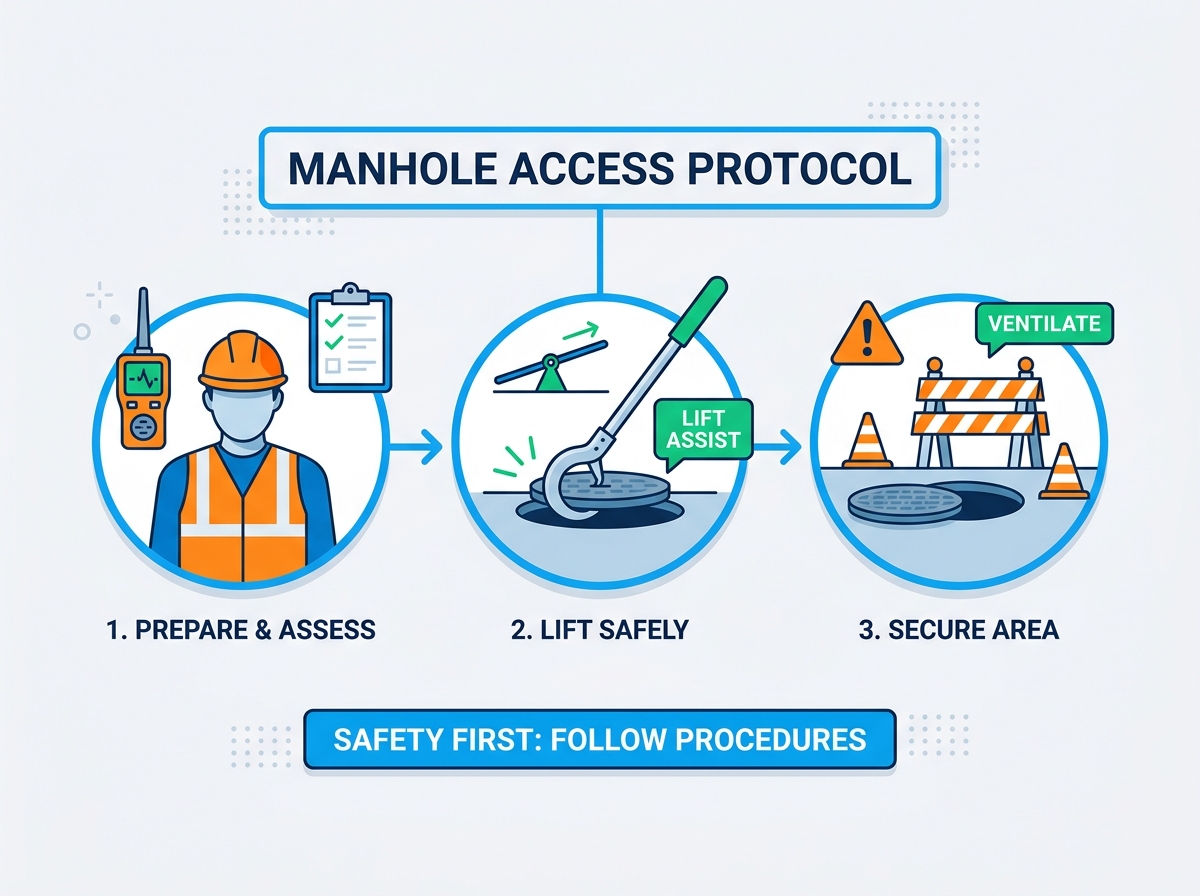
Safety begins before anyone touches a tool. Securing the site prevents civilian accidents and protects the crew from vehicular traffic. Underground environments accumulate lethal gases rapidly, making atmospheric testing a mandatory first step.
Clear all lifting eyes, slots, or keyways of debris to ensure full tool engagement. Use a pick or chisel to scrape out compacted mud and asphalt. Never attempt a lift with a partially engaged hook. Partial engagement concentrates the lifting force on a tiny sliver of metal. This leads to sudden tool breakage or violent slippage during a heavy lift, often resulting in backward falls, shattered teeth, and severe spinal injuries.
Do not use your back to fight a stuck cover. Use technical methods to dislodge frozen, rusted, or asphalt-bound covers without damaging the infrastructure. Non-sparking brass wedges can be driven into the rim gap to break rust bonds. Specialized pry bars offer initial leverage to crack the seal. Penetrating release agents help dissolve galvanic corrosion over a few minutes.
Seasonal challenges require specific tactics. Use thermal de-icing agents or hot water for winter-frozen covers. In high-temperature environments, use a cold chisel to score and scrape away softened asphalt seals before lifting. Never use open flames or blowtorches to thaw a cover. Never strike cast iron with standard steel sledgehammers. These actions create severe spark hazards and risk shattering the brittle cast iron into dangerous shrapnel.
Execute the lift using precise ergonomic steps to protect the lower back. If mechanical assistance is unavailable, establish protocols for coordinated two-person manual lifts. Both workers must communicate clearly and lift in unison.
Before replacing the cover, clean the frame seat thoroughly. Scrape away dirt, rust flakes, and pebbles using a wire brush. A clean seat prevents future binding and stops the cover from rocking under traffic, which causes noise complaints and frame damage. Align any registration marks on the cover with the corresponding marks on the frame to ensure proper locking. Finally, perform physical verification checks. Step on the edges to ensure the cover sits completely flush with the pavement, eliminating any trip hazards or risks to passing snowplows.
Removing a utility cover immediately exposes a confined space. This triggers specific OSHA confined space protocols under 29 CFR 1910.146. An open manhole is a recognized fall hazard. Once the cover is removed, crews must install temporary fall protection barriers, such as guardrails or manhole shields, around the opening. Continuous ventilation is often required to purge toxic gases and introduce fresh air before any worker crosses the threshold. An attendant must remain topside at all times while personnel are inside the vault.
Standard steel tools pose a severe explosion hazard in specific environments. Sewer gases, proximity to natural gas lines, and chemical runoff create highly combustible atmospheres. Striking a steel hook against an iron cover can generate a spark, igniting the vault and causing a catastrophic explosion. Evaluate the procurement of beryllium copper or aluminum bronze hooks and lifters. These non-sparking alloys ensure intrinsic safety when working in potentially explosive zones, providing peace of mind for crews operating in older municipal sewer systems.
Safety officers and procurement teams must look beyond the initial purchase order. You can easily justify the cost of premium mechanical lifters by calculating the avoided costs of a single ergonomic injury. A severe lower back strain involves medical bills, lost productivity, temporary replacement labor, and increased insurance premiums. High-quality mechanical dollies and magnetic systems prevent these injuries entirely. Investing in durable, ergonomically sound equipment keeps crews in the field, maintains project schedules, and protects the organization's bottom line.
A: Mechanical leverage dollies offer the highest safety margin. They use a wheeled fulcrum to break heavy seals, removing the physical strain from the worker's lower back and preventing crush injuries by keeping the operator away from the open hole.
A: Standard cast iron municipal covers typically weigh between 90 and 250 pounds. Heavy-duty covers used in highways or airports can exceed 400 pounds, while modern composite covers are significantly lighter, often weighing under 100 pounds.
A: Clean the edges and keyways first. Apply a penetrating release agent or de-icing solution. Use a non-sparking wedge to break the rust or ice seal gently before applying a mechanical lifter. Never strike the cover with a steel hammer.
A: Magnetic lifters require clean, flat contact with bare iron to achieve their maximum hold. They are less effective on heavily textured surfaces and will not work if thick mud, asphalt, or debris blocks the magnetic connection.
A: OSHA requires immediate protection of the opening to prevent accidental falls. Crews must deploy temporary barricades or railings. Atmospheric testing and continuous ventilation protocols are also triggered under confined space entry regulations.
A: Sewers and utility vaults often trap combustible gases like methane or hydrogen sulfide. Striking standard steel tools against an iron cover can create sparks, potentially triggering a lethal underground explosion. Non-sparking alloys prevent this ignition risk.


