
Views: 0 Author: Site Editor Publish Time: 2026-07-14 Origin: Site


Unverified flooring and walking surfaces in commercial, industrial, municipal, and public environments carry hidden financial and legal liabilities that organizations often overlook until an incident occurs. Relying on visual inspections, outdated manufacturer specifications, or subjective assessments leaves facility managers and property owners vulnerable to slip-and-fall litigation, regulatory fines, and severe workplace injuries. When safety protocols rely on guesswork rather than hard data, the physical well-being of employees and patrons is compromised alongside the financial stability of the operation.
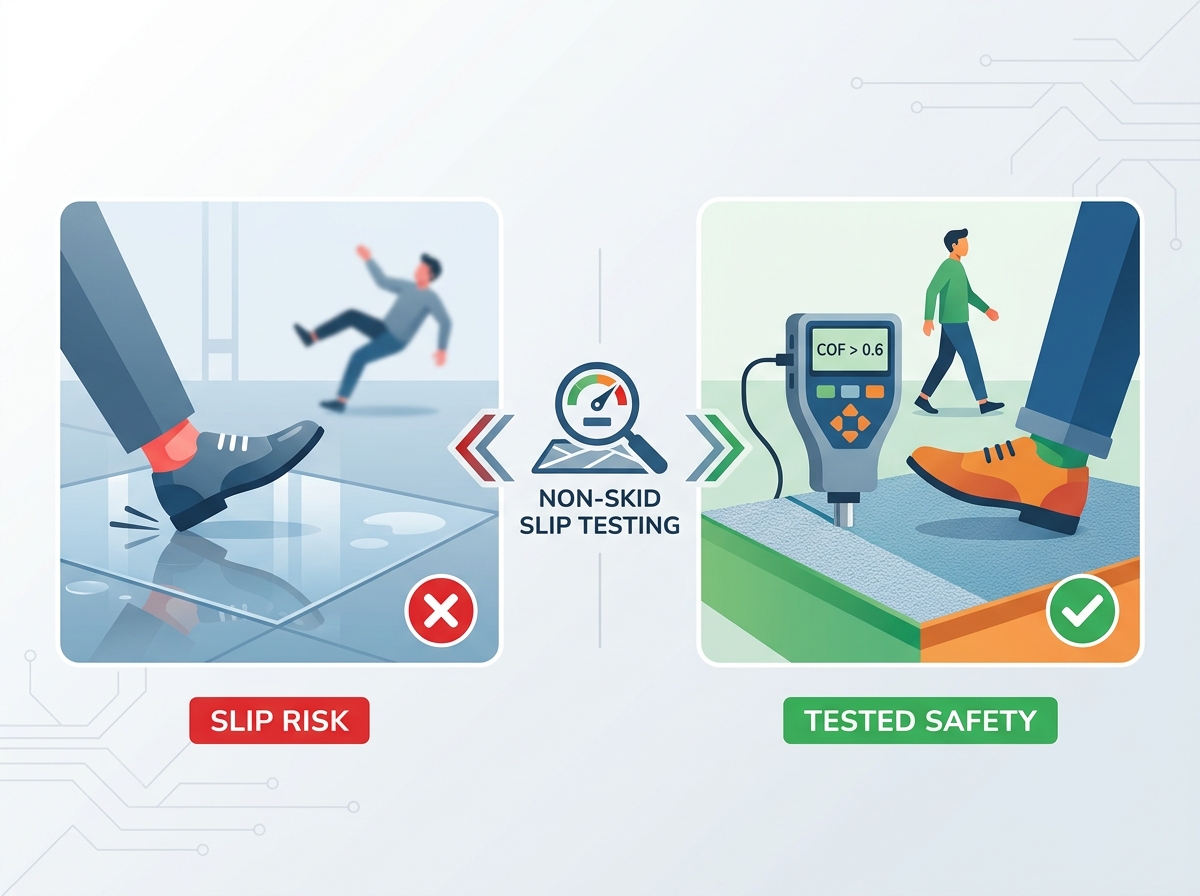
The most effective method to mitigate these risks involves adopting empirical, defensible testing protocols to quantify surface safety. Implementing non-skid slip testing provides the objective data necessary to prove compliance with national safety standards and select appropriate anti-slip remediation strategies. By replacing assumptions with measurable facts, operations managers can proactively manage environmental risks, defend against negligence claims, and maintain secure walking surfaces across all facility zones.
Slip resistance relies on measuring the Coefficient of Friction (COF). This metric quantifies the resistance to movement between two surfaces, specifically the interaction between a shoe sole and a floor substrate or metal utility plate. Higher COF values indicate greater slip resistance, meaning the surface provides better traction underfoot. Understanding this mechanical interaction is the first step in managing floor safety effectively across diverse environments. When a heel strikes a surface, the micro-texture of the flooring must interlock with the footwear material to prevent a loss of traction. If the surface is too smooth, or if a contaminant acts as a barrier between the shoe and the floor, the COF drops significantly, leading to a slip event.
Field technicians measure this interaction using specialized equipment that calculates the exact ratio of the force of friction between the two bodies and the force pressing them together. This is not a subjective "feel" test. It is a precise mathematical evaluation that yields a specific number. Facility managers use this number to determine if a floor meets the minimum safety thresholds required for its specific use case, whether that is a dry office lobby or a wet commercial kitchen.
There is a critical difference between Static Coefficient of Friction (SCOF) and Dynamic Coefficient of Friction (DCOF). SCOF measures the force required to initiate movement from a resting position. Imagine standing perfectly still and then trying to push your foot forward. DCOF, on the other hand, measures the force required to keep an object in motion. Modern safety standards heavily favor DCOF because it more accurately simulates human walking mechanics. When a person walks, their heel is already in motion when it strikes the ground. Therefore, measuring the friction of a moving object provides a much more realistic assessment of slip risk.
Historically, many industries relied on SCOF measurements, often using simple drag-sled devices. However, extensive biomechanical research demonstrated that SCOF does not correlate well with actual human slip-and-fall events. A floor might have a high SCOF but a dangerously low DCOF, meaning a person standing still feels secure, but the moment they take a normal stride, their foot slides out from under them. Transitioning to DCOF testing has revolutionized floor safety by aligning testing methodologies with actual human movement patterns.
Testing is vital during the architectural specification phase. It determines if a flooring material, metal utility plate, or transition strip is safe for its intended environment before installation. Pre-installation testing prevents costly mistakes by ensuring materials meet safety requirements before they are permanently affixed in a facility. Architects and specifiers often request laboratory testing of material samples to verify their DCOF ratings under various conditions.
This proactive approach saves organizations from the massive expense of ripping out and replacing non-compliant flooring. For example, a polished marble tile might look stunning in a design rendering for a hotel lobby, but pre-installation testing might reveal that its DCOF drops to dangerous levels when tracked with rainwater. Armed with this data, the design team can select a different material or specify a factory-applied anti-slip treatment before the first tile is ever laid.
A tribometer is the specialized equipment used to measure slip resistance. It establishes the technical foundation for evaluating floor and surface slipperiness. Tribometers apply a specific force and measure the resulting friction, providing the objective data needed for compliance and safety audits. These devices range from simple mechanical pendulums to highly advanced digital units that record continuous friction profiles across a surface.
Operating a tribometer requires specific training to ensure accurate and repeatable results. The technician must prepare the sensor material, calibrate the device, and execute the test according to strict standardized protocols. The data generated by the tribometer is then compiled into a formal report, which serves as the official record of the floor's safety performance at that specific point in time.
Adhering to regulatory standards is mandatory for any operational facility. OSHA General Industry standard 1910.22 mandates that all walking and working surfaces must be maintained in a safe condition. ADA guidelines require accessible routes to be stable, firm, and slip-resistant. Furthermore, the ANSI A326.3 standard provides specific DCOF requirements for hard surface floor materials. Compliance with these standards forms the basis of a defensible safety program.
When an incident occurs, regulatory bodies and legal teams will immediately request documentation proving that the facility met these standards. Without empirical testing data, an organization has no defense. They cannot prove that the floor was safe at the time of the incident. Regular testing creates a paper trail of compliance, demonstrating that the facility management took reasonable and proactive steps to maintain a safe environment.
The cost of slip-and-fall litigation far exceeds the cost of routine testing. Documented testing histories serve as primary evidence in defending against negligence claims. When an organization can prove it regularly monitors and maintains surface safety, it significantly reduces its financial exposure to lawsuits, settlements, and insurance premium hikes.
Consider the financial mechanics of a typical slip-and-fall claim. The plaintiff's attorney will argue that the floor was inherently dangerous and that the facility owner knew or should have known about the hazard. If the facility owner can produce a recent tribometer report showing that the floor's DCOF exceeded the ANSI A326.3 minimum requirements, the plaintiff's argument is severely weakened. This empirical evidence often leads to claims being dismissed or settled for a fraction of the initial demand.
Different environments present unique slip hazards that require specific attention and tailored testing protocols.
The Pendulum tester is a globally recognized standard for slip testing. It uses a swinging arm equipped with a spring-loaded rubber slider to simulate a heel strike on the floor surface. As the pendulum swings and the rubber slider contacts the floor, the friction slows the arm's momentum. A pointer on a scale indicates the British Pendulum Number (BPN) or Pendulum Test Value (PTV). This method is highly reliable on both flat flooring and heavily textured industrial surfaces, making it incredibly versatile for various field applications.
One of the primary advantages of the Pendulum tester is its ability to evaluate rough, profiled, or uneven surfaces where digital drag-sled tribometers might get stuck or produce erratic readings. It is frequently used for testing exterior paving, road surfaces, and industrial grating. The device requires meticulous calibration and leveling before each use, and the rubber sliders must be conditioned properly to ensure accurate results.
The BOT-3000E is the industry standard for measuring DCOF under the ANSI A326.3 standard. It is a self-propelled, digital device that crawls across the floor surface, measuring the dynamic friction continuously over a set distance. It features an automated testing process and robust data logging capabilities, generating a precise graph of the friction profile and calculating the average DCOF. This device is particularly suitable for indoor hard surfaces, providing highly consistent and repeatable results.
The BOT-3000E eliminates much of the operator error associated with manual testing devices. The technician simply prepares the sensor (usually a standardized SBR rubber), applies the required wetting agent (typically a 0.05% SLS water solution), and presses a button. The machine handles the rest, ensuring the speed and downward force remain perfectly constant throughout the test run.
Variable angle ramp testing involves human test subjects walking on inclined ramps coated with specific contaminants. These specialized laboratory testing methods are used primarily during the manufacturing phase of anti-slip flooring and footwear to establish baseline slip ratings. The ramp is slowly tilted upward until the test subject slips. The angle at which the slip occurs determines the floor's "R-rating" (for oil-wet conditions) or "A/B/C rating" (for barefoot wet conditions).
While ramp testing provides excellent baseline data for material specification, it cannot be performed in the field. It is strictly a laboratory procedure used to classify materials before they are sold. Facility managers use these ratings when purchasing new flooring, but they must still rely on portable tribometers to verify the floor's performance after installation and over time.
| Testing Method | Primary Use Case | Standard | Environment |
|---|---|---|---|
| Pendulum Tester | Versatile, simulates heel strike, handles rough textures | BS EN 16165 / ASTM E303 | Indoor / Outdoor / Industrial |
| BOT-3000E | Indoor hard surfaces, automated digital logging | ANSI A326.3 | Indoor Commercial / Retail |
| Variable Angle Ramp | Laboratory baseline rating for material classification | DIN 51130 / DIN 51097 | Laboratory Only |
Testing floors and industrial surfaces only in pristine, dry conditions creates a false sense of security. It fails to reflect real-world operational hazards where spills, tracked-in moisture, and debris are common occurrences. Almost any hard surface will yield a passing DCOF score when perfectly clean and dry. However, a surface that passes a dry test may fail miserably the moment it becomes wet. Relying solely on dry testing data leaves a facility completely blind to its actual slip risk during normal operational conditions.
Standardized testing protocols, such as ANSI A326.3, explicitly require testing under wet conditions for surfaces expected to be walked upon when wet. This is because water acts as a lubricant, preventing the shoe sole from interlocking with the floor's micro-texture. By testing the floor in its most vulnerable state, facility managers gain an accurate understanding of the true hazard level.
Accurate testing requires simulating the actual conditions the surface will face during daily operations. Different environments require different contaminant profiles during the testing phase.
Heavy foot traffic, abrasive cleaning routines, and UV exposure degrade slip-resistant coatings and surface textures over time. The sharp microscopic peaks that provide traction are slowly worn down, smoothing out the surface and reducing its DCOF. This degradation necessitates ongoing testing rather than one-off assessments. A floor that passed a slip test immediately after installation may fail the same test two years later due to normal wear and tear.
Regular monitoring ensures the surface maintains its required safety profile throughout its lifecycle. When testing reveals that a floor's DCOF is trending downward, facility managers can proactively schedule deep cleaning, chemical etching, or the application of a new anti-slip coating before the floor becomes a severe hazard.
Purchasing tribometers requires an initial capital expenditure, which can range from a few thousand dollars for a basic pendulum to over ten thousand dollars for an advanced digital unit like the BOT-3000E. It also involves ongoing staff training, regular equipment calibration, and dedicated time for maintenance personnel to conduct the tests. However, the primary benefit is immediate, on-demand auditing. Facility managers can check surfaces whenever needed, such as immediately following a spill, after a new cleaning protocol is implemented, or right after a slip-and-fall incident occurs.
In-house testing is highly effective for routine monitoring and rapid response. However, the data generated internally may be viewed with skepticism during litigation, as opposing counsel may argue that the internal staff lacked proper certification or manipulated the results to protect the company.
Hiring independent, certified professionals offers significant value, particularly regarding legal defensibility. Third-party reports carry superior legal weight in court because they eliminate internal bias. An accredited testing agency provides an objective, expert assessment of facility safety, utilizing calibrated equipment and certified technicians who specialize exclusively in floor friction analysis.
Furthermore, third-party experts can provide comprehensive risk assessments, identifying hazardous areas that internal staff might overlook. They can also offer expert testimony during litigation, explaining the testing methodology and the results to a judge or jury. While this approach incurs an ongoing service cost, the legal protection it provides often outweighs the expense.
Choosing an approach depends on several operational factors. Facility managers should evaluate their specific needs using a structured framework.
Establish baseline metrics by testing newly installed flooring, external utility covers, or newly applied anti-slip treatments before opening the area to traffic. This baseline provides a reference point for future audits and ensures initial compliance with safety standards. The baseline test confirms that the contractor delivered a product that meets the specified safety requirements. If the new floor fails the baseline test, the facility manager can demand remediation from the contractor before accepting the work.
Baseline testing should be conducted under both dry and wet conditions, using the specific contaminants expected in that environment. The results must be formally documented and stored in the facility's permanent maintenance records.
Determine how often to test based on traffic volume, environmental exposure, and the specific risk profile of each zone. Consistent scheduling is key to effective risk management and demonstrating a proactive safety culture.
When a surface fails a slip test, actionable steps are required immediately to secure the area and correct the hazard. The chosen strategy should address the specific cause of the failure and the operational needs of the space.
| Remediation Strategy | Application | Durability |
|---|---|---|
| Chemical Etching | Mineral-based floors (tile, concrete) | Medium - alters microscopic texture |
| Abrasive Epoxy Coatings | Industrial floors, loading docks, ramps | High - withstands heavy machinery |
| Non-Skid Tapes | Stair treads, transition strips, localized hazards | Low to Medium - requires frequent replacement |
| Mechanical Grinding | Concrete, stone, uneven transitions | Permanent - physically alters the substrate |
| Deep Extraction Cleaning | Floors suffering from polymerized grease buildup | Variable - depends on ongoing maintenance |
Implementing rigorous testing protocols is a mandatory requirement for facility safety, legal protection, and operational continuity. Relying on visual inspections or outdated specifications leaves organizations exposed to severe financial and legal liabilities. Selecting the right testing methodology and execution strategy depends entirely on specific facility risks, surface types, and operational demands.
A: Under the ANSI A326.3 standard, a DCOF of 0.42 or greater is generally required for level, indoor hard surfaces expected to be walked upon when wet. However, specific environments, such as ramps or areas exposed to heavy grease, require higher ratings based on detailed risk assessments.
A: Frequency depends entirely on traffic volume and environmental factors. High-risk areas prone to liquid contamination should be tested quarterly. Lower-risk, dry areas typically require annual testing to monitor long-term wear and tear degradation.
A: Yes. Modern tribometers, including the BOT-3000E and Pendulum testers, are designed to evaluate surfaces without causing any physical damage. This makes them ideal for in-situ testing of existing floors during normal facility operations.
A: SCOF measures the friction needed to start moving from a complete standstill. DCOF measures the friction required to keep an object moving. DCOF is the preferred metric for safety testing because it accurately simulates the mechanics of human walking.
A: Dry contaminants act like microscopic ball bearings between the shoe and the floor, drastically reducing friction and causing sudden slips. They require specific testing protocols, as a surface that is safe when wet might become highly hazardous when covered in dry powder.
A: No testing guarantees absolute immunity from litigation. However, maintaining documented, regular testing that proves compliance with national standards provides a highly effective, empirical defense against negligence claims in court.
A: Wet conditions typically lower the coefficient of friction by creating a lubricating barrier between the sensor and the floor. Testing under wet conditions is essential because it reveals the surface's actual safety performance during its most hazardous operational state.


