
Views: 0 Author: Site Editor Publish Time: 2026-07-15 Origin: Site


Selecting the correct access cover for an infrastructure project requires matching structural capacity to actual site conditions. Under-specifying access covers in load-bearing zones leads to structural collapse, immediate safety hazards, and severe damage to underground utility networks. Facility managers, civil engineers, and municipal operators must evaluate load ratings, traffic patterns, material science, and regulatory compliance standards to secure safety and protect the overall infrastructure investment.
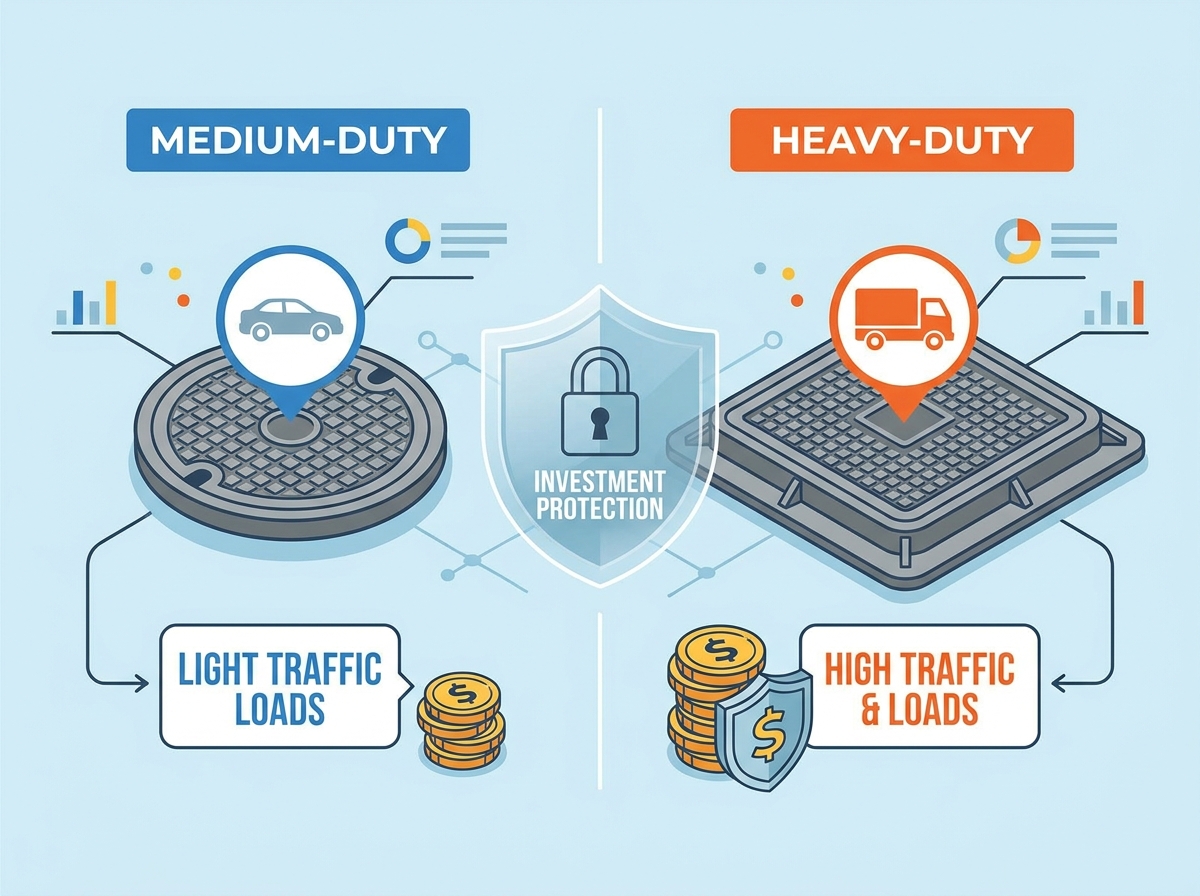
The engineering debate between medium duty vs heavy duty manhole covers comes down to a strict, data-driven evaluation of how dynamic wheel loads transfer through the casting and into the surrounding pavement. By understanding the distinct engineering criteria, material properties, and operational environments for each class of cover, you can specify the correct assembly and prevent premature mechanical failure. This guide breaks down the critical specifications, material differences, and implementation risks to help you execute a successful installation.
| Specification Parameter | Medium-Duty Covers | Heavy-Duty Covers |
|---|---|---|
| Load Rating Standards | EN 124 Class B125 / C250 | AASHTO M306 (H-20/HS-20), EN 124 Class D400 / E600 |
| Typical Proof Load Capacity | 12,500 to 25,000 lbs | 40,000 to 100,000+ lbs |
| Primary Material Compositions | Gray Cast Iron, Steel, Polymer Composites | Ductile Iron, High-Density FRP Composites |
| Target Installation Environments | Driveways, pedestrian plazas, light parking lots | Highways, loading docks, airports, industrial ports |
| Dynamic Load Handling | Low impact, static loads, slow rolling tires | High impact, braking shear, high-speed wheel bounce |
| Frame Seating Design | Standard machined flat seat | Gasketed, multi-point bolted, deep seating depth |
Medium-duty access covers withstand pneumatic tire traffic up to specific gross vehicle weights. These castings typically align with EN 124 Class B125 or C250 standards, meaning they handle light-to-medium commercial ratings. They lack the structural mass and metallurgical properties required to absorb the dynamic impact of fast-moving heavy trucks or the concentrated point loads of industrial equipment.
You will find medium-duty covers installed in residential driveways, pedestrian plazas, school campuses, low-speed parking facilities, and landscaped green spaces. These environments experience predictable, low-impact traffic. A delivery van or a utility cart might occasionally roll over the casting, but the frequency and speed of these events remain low.
Success metrics for medium-duty installations focus on manual ease of removal for routine maintenance and adequate slip resistance for pedestrian safety. The casting must offer sufficient fatigue resistance to handle occasional, non-commercial vehicle rollovers without developing micro-fractures in the web structure. When installed correctly flush with the surrounding hardscape, a medium-duty cover provides decades of reliable service in restricted traffic zones.
Heavy-duty specifications center on strict AASHTO H-20 and HS-20 truck loading protocols. These standards require a 40,000-lb proof load test under AASHTO M306 guidelines, applied to the center of the casting using a 9-inch by 9-inch steel plate to simulate a dual-tire footprint. In European standards, they align with EN 124 Class D400 or E600 ratings, ensuring they support massive, concentrated wheel loads from commercial freight.
These covers are mandatory for public highways, commercial loading bays, bus terminals, airport tarmacs, ports, and industrial heavy-equipment paths. Any environment where heavy commercial vehicles brake, accelerate, or turn sharply requires a heavy-duty rating. The braking shear force generated by a fully loaded tractor-trailer stopping directly on top of a manhole cover will instantly shatter a medium-duty casting.
The success metrics for heavy-duty covers demand zero deflection under high cyclic dynamic loads. They must absorb dynamic impacts, including wheel bounce from uneven pavement transitions. Furthermore, they require high slip resistance, deep frame seating to prevent pop-outs, and strict compliance with local and federal Department of Transportation regulations regarding material sourcing and load verification.
Ductile iron, specifically grades like 65-45-12 or 80-55-06, serves as the industry benchmark for heavy-duty covers. Its spheroidal graphite structure provides high yield strength and elongation properties. Unlike brittle gray iron, which fractures catastrophically under sudden impact, ductile iron bends slightly under extreme stress. This elasticity allows the casting to absorb the shock of heavy commercial traffic and return to its original shape without structural degradation.
High-density, fiber-reinforced polymer (FRP) composites offer a viable alternative for both medium and heavy-duty applications. These composite materials provide exceptional corrosion resistance against sewer gases and road salts. They possess zero scrap metal value, acting as a natural theft deterrent in remote or unmonitored locations. Furthermore, FRP composites are radio frequency transparent, allowing utility companies to install smart grid monitoring antennas directly beneath the cover without signal interference.
The underside structural engineering of a heavy-duty cover dictates its load-bearing capacity. Manufacturers utilize deep reinforcing ribs, radial web structures, and optimized thickness profiles to disperse heavy wheel loads evenly across the frame seat. This engineering prevents concentrated point-loading that leads to radial cracking. The depth of the cover itself is usually significantly thicker than a medium-duty counterpart to accommodate these structural ribs.
Proper seating, gaskets, and noise mitigation are essential for covers exposed to high-speed traffic. Machined mating surfaces ensure the cover sits perfectly flat within the frame. Neoprene or EPDM gaskets, combined with multi-point bolting assemblies, prevent rattling, lateral cover movement, and dynamic pop-outs. When a vehicle drives over a loose cover at highway speeds, the resulting vacuum and vibration can suck the cover entirely out of the frame, creating a lethal hazard.
Security and locking systems vary based on the application. Medium-duty covers often use simple drop-in designs, concealed pick holes, or basic cam locks. Heavy-duty covers protecting critical underground utility networks employ robust mechanical locking systems, penta-head bolts, and high-security tamper-proof fasteners to prevent unauthorized access to fiber optic vaults, electrical splices, or municipal water valves.
Underground utility environments expose castings to harsh conditions. Exposure to hydrogen sulfide gas from sanitary sewers, industrial chemical runoff, and winter deicing salts severely degrades structural integrity over time. Heavy-duty covers, particularly those manufactured from specialized composites or coated ductile iron, resist these corrosive elements far better than untreated gray iron.
Water-tightness and gas-tightness dictate specific design features. Specialized heavy-duty bolt-down, gasketed covers prevent surface water inflow during severe storm events, protecting sanitary sewer systems from hydraulic overloading. Conversely, these same sealed systems stop noxious sewer gases from escaping into public pedestrian areas or commercial facilities.
Material performance during extreme freeze-thaw cycles and direct solar radiation requires careful evaluation. Thermal expansion properties dictate frame joint spacing and material selection. A cover must not bind tightly in the frame during peak summer heat, nor become brittle and prone to impact fracture during sub-zero winter temperatures.
Installing medium-duty covers generally requires standard hand tools and minimal heavy equipment. A small crew can manually lift and position the frame, set the grade rings, and drop the cover into place. The lighter weight of the materials accelerates the installation timeline and reduces the physical strain on the utility crew.
Heavy-duty systems demand extensive civil works and specialized equipment. The sheer weight of a ductile iron heavy-duty frame and cover assembly often necessitates a skid steer, backhoe, or dedicated hoisting equipment for safe positioning. Crews must utilize high-early-strength concrete collars and precise grade adjustment rings to ensure the frame transfers massive dynamic loads into the surrounding pavement structure without settling.
When a medium-duty cover is subjected to heavy-duty traffic, the physical failure modes are rapid and severe. The most common failure is radial cracking, where fractures propagate from the center of the cover outward toward the edge. Once a crack reaches the outer edge, the structural integrity drops to zero, and the next heavy wheel load will push the broken pieces directly into the utility vault.
Frame seat degradation is another consequence. The constant flexing of an under-specified cover grinds against the frame seat. This metal-on-metal wear eventually creates a loose fit. The cover begins to rattle, shifting laterally under traffic, which accelerates the wear until the cover slips through the frame entirely.
Operational disruption follows any catastrophic material failure. Emergency lane closures, immediate detours, and unscheduled utility access delays drain municipal resources. Repairing a collapsed cover requires saw-cutting the surrounding asphalt, excavating the damaged frame, and pouring a completely new concrete collar, shutting down the traffic lane for days while the new concrete cures.
Installing a medium-duty cover in an area that later experiences an escalation in traffic volume guarantees premature failure. A residential development might initially see only passenger cars, but subsequent construction phases will bring heavy concrete trucks, flatbed delivery vehicles, and heavy earth-moving equipment directly over the installed utility covers.
Mitigate this risk by mapping out a long-term traffic projection plan. Default to a heavy-duty rating if municipal rezoning, future construction traffic, or commercial routing changes are anticipated. Evaluating the turning radius of large vehicles is also critical; covers located in intersections or tight corners experience massive lateral shear forces from turning truck tires, requiring heavy-duty specifications regardless of overall traffic volume.
Installing a new heavy-duty cover into an existing, worn, or medium-duty frame causes immediate mechanical breakdown. The new cover will not seat properly in the old frame. This mismatch results in uneven seating and intense point-loading. The weaker medium-duty frame cannot transfer the heavy commercial loads to the surrounding concrete, leading to rapid frame fracture.
Mandate a comprehensive structural inspection of the frame seat and concrete collar prior to specification. When upgrading load capacities, always replace the frame and cover as a matched, factory-certified assembly. Manufacturers machine the cover and frame together to ensure a flush, rattle-free fit that distributes weight evenly across the entire flange.
Improper grading, poor backfill compaction, or low-quality mortar under the frame lead to uneven surface transitions. If a cover sits even half an inch below the pavement surface, every rolling tire drops into the depression, striking the edge of the casting with exponential impact force. This acts exactly like a pothole, destroying the concrete collar and shattering the casting.
Enforce strict adherence to ASTM and local DOT installation guidelines. Ensure the top of the cover is flush with the finished pavement surface within specified micro-tolerances. Use high-quality epoxy mortars for final leveling rather than standard brick mortar, which crumbles under heavy vibration. Proper installation execution is just as critical as selecting the correct load-rated casting.
Selecting the correct access cover requires matching the engineering specifications to the physical reality of the installation environment. Evaluate current traffic loads, anticipate future development, and understand the material properties of the castings you specify.
A: Medium-duty covers typically support proof loads between 12,500 and 25,000 lbs (EN 124 Class B125/C250), suitable for light traffic. Heavy-duty covers must withstand a minimum 40,000-lb proof load (AASHTO M306 / EN 124 Class D400) to handle commercial trucks and highway speeds safely.
A: An AASHTO H-20/HS-20 rating means the cover is engineered to safely support a 16,000-pound wheel load, simulating a heavy commercial tractor-trailer. It requires passing a 40,000-pound proof load test, ensuring the cover will not fail under dynamic highway traffic conditions.
A: Yes, medium-duty covers are generally appropriate for residential driveways, as they easily support standard passenger cars and SUVs. However, if the driveway frequently accommodates heavy delivery trucks or RVs, upgrading to a heavy-duty cover prevents radial cracking.
A: Check the top surface of the cover for cast-in markings. Look for designations like "H-20," "HS-20," "M306," or "D400" for heavy-duty, or "B125" or "C250" for medium-duty. If no markings exist, a civil engineer must evaluate the thickness, ribbing, and material.
A: Mounting a heavy-duty cover in a medium-duty frame causes uneven seating and point-loading. The weaker frame cannot transfer the heavy loads to the surrounding concrete, leading to rapid frame fracture, pavement failure, and eventual collapse of the entire assembly.
A: Yes, high-density, fiber-reinforced polymer composite covers can be engineered to meet and exceed AASHTO H-20 and EN 124 D400 heavy-duty requirements. They offer the load capacity of ductile iron while providing corrosion resistance and significant weight reduction.
A: Medium-duty covers often use simple drop-in designs or basic hook locks. Heavy-duty covers in critical infrastructure utilize robust mechanical locking systems, penta-head bolts, and multi-point bolting assemblies to prevent unauthorized access and stop the cover from dislodging under high-speed traffic.


