
Views: 0 Author: Site Editor Publish Time: 2026-07-13 Origin: Site


Selecting a manhole cover extends far beyond basic hardware procurement. It represents a strict infrastructure decision directly impacting site security, public liability, and long-term municipal maintenance budgets. Civil engineers and utility managers constantly face an operational tension between rapid utility accessibility for fast maintenance entry and physical asset security. Preventing unauthorized access, resisting dynamic vehicle displacement, and managing hydraulic backpressure demand specific mechanical configurations. Understanding the mechanical distinctions of lay-in vs bolt-down manhole covers is essential for resolving this tension. Selecting the appropriate feature depends on a rigorous engineering evaluation of site-specific compliance, environmental pressures, and traffic dynamics. You cannot simply guess which cover works best; you must evaluate the physical realities of the installation environment.
Defining infrastructure requirements requires establishing baseline engineering metrics for success. These metrics include AASHTO M306 or EN 124 load ratings, site-specific security mandates, and anticipated environmental exposure. A cover placed in a pedestrian walkway faces entirely different stress factors than one installed in a high-speed highway lane. Engineers must evaluate the specific physical demands of the installation site before determining the necessary mechanical features. You have to look at the daily traffic volume, the type of vehicles passing over the casting, and the potential for standing water.
A fundamental engineering constraint is that manhole placement is dictated strictly by underground utility routing, not surface convenience. This lack of positional control forces infrastructure planners to adapt the surface hardware to the environment. When utilities run directly through high-stress areas like vehicle wheel paths or low-lying flood basins, the fixed location necessitates robust mechanical solutions to prevent failure. You cannot simply move the access point to a safer area. The pipe dictates the location, and the surface hardware must adapt to whatever hazards exist at that specific coordinate.
Risk assessment plays a central role in this selection process. Civil engineers must balance the probability of unauthorized entry, hazardous gas accumulation, or physical displacement against the necessity for rapid emergency access. A sealed, bolted cover prevents unauthorized entry but slows down utility crews responding to a critical line failure. Evaluating these competing priorities ensures the chosen hardware aligns with the actual operational reality of the site. If a sewer line backs up at 2 AM, crews need to get the lid off fast. If that lid is bolted down and the bolts are seized, a minor backup turns into a major sanitary overflow.
Regulatory and compliance lenses further complicate the decision. OSHA considerations for confined space entry dictate specific gas detection and ventilation requirements. Municipal codes often mandate specific cover security measures in public right-of-ways to protect pedestrians and vehicles. Compliance with these standards is non-negotiable and heavily influences whether a gravity-held or mechanically fastened cover is specified. You must check local municipal standards before finalizing any hardware schedule.
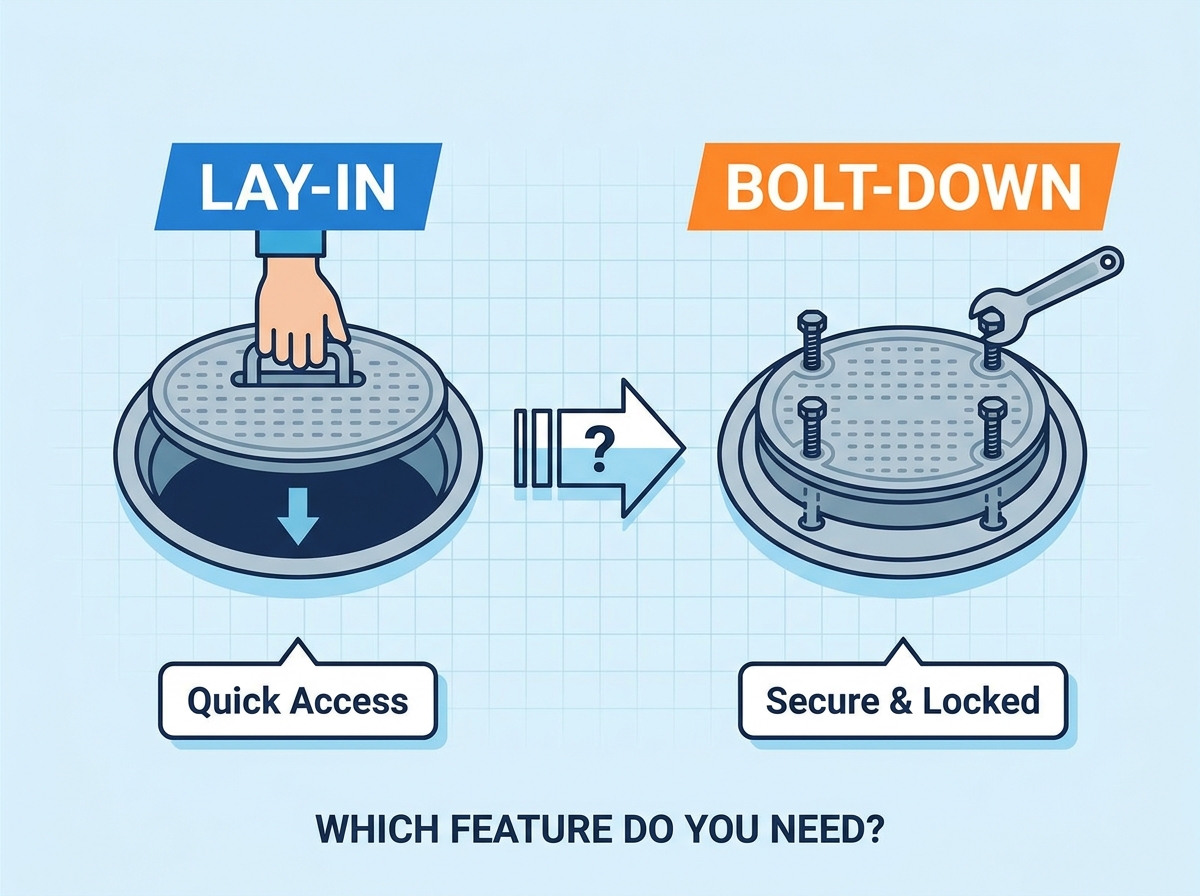
The mechanical design of a lay-in cover relies entirely on gravity. The physical mass of the cast or ductile iron cover, combined with the precision of the machined frame seating, keeps the unit flush and stable. There are no mechanical fasteners, hinges, or locks. The cover simply rests within the frame, utilizing its own weight to resist minor surface disruptions. The machining tolerance between the lid and the frame is what prevents rattling. If the casting is poor, the lid will bounce every time a car hits it.
Round lay-in covers utilize the inherent strengths of circle geometry. A round cover cannot accidentally fall through its circular frame opening, regardless of how it is rotated or positioned. This geometric efficiency minimizes material volume and manufacturing complexity compared to square or rectangular variants. The result is a highly functional, structurally sound access point that requires less raw material to produce. Field crews prefer round covers because they can roll them across the pavement rather than carrying them.
Operational advantages center on the speed of utility access. Maintenance crews can remove a lay-in cover quickly using standard lifting hooks or pry bars. The elimination of mechanical fasteners removes the need to maintain, replace, or lubricate bolts. This simplicity lowers the risk of hand or tool-related injuries during removal, allowing crews to inspect and service underground networks with maximum efficiency. When you have a crew checking fifty sanitary sewer manholes in a single shift, the time saved by not unbolting lids is massive.
However, lay-in configurations possess primary vulnerabilities. They are susceptible to displacement from high-speed heavy traffic, where dynamic wheel suction and horizontal braking forces can dislodge the lid. Their unfastened nature makes them vulnerable to metal theft. Furthermore, during severe storm sewer surcharge events, hydraulic backpressure can cause dangerous blow-offs, turning heavy iron covers into hazardous projectiles. A 150-pound cast iron lid flying through the air during a flood is a massive liability.
Ideal deployment zones for lay-in covers include:
The mechanical design of a bolt-down cover incorporates a fastening system that anchors the lid to threaded receptacles within the frame. This system typically utilizes hex bolts, tamper-proof pentagon-head screws, or integrated cam locks. By physically securing the cover to the frame, the assembly functions as a single, unified structural unit capable of resisting significant upward and lateral forces. The bolts take the shear stress when a truck locks its brakes directly over the casting.
Mechanical bolting provides distinct security and stability advantages. It deters unauthorized access by requiring specialized tools for removal. Bolting eliminates cover rattling and noise under heavy traffic, a common complaint in urban environments. Most importantly, it provides secure resistance against vertical displacement caused by tire suction or hydraulic pressure. When you bolt the lid down, it stays exactly where you put it, regardless of what drives over it or what pressure builds up underneath it.
Watertight and odor-control capabilities are significantly enhanced by bolt-down mechanisms. The mechanical fasteners allow for uniform compression of neoprene or EPDM gaskets seated between the cover and the frame. This compression creates a sealed environment that prevents surface water inflow and infiltration (I&I) into sanitary sewers, while simultaneously preventing noxious sewer gases from escaping into the surrounding environment. You cannot achieve a true watertight seal without mechanical compression. Gravity alone will not compress a rubber gasket enough to stop water.
Geometric considerations heavily influence the need for fasteners. Square and rectangular utility hatches rely heavily on bolt-down configurations to prevent corner warping and rocking under load. Unlike round covers, straight-edged geometries distribute weight unevenly. Bolting the corners ensures the hatch remains flat, stable, and capable of maintaining a watertight seal across its entire perimeter. If you install a large rectangular hatch in a traffic lane without bolting it, the corners will eventually bend upward under the repeated stress of truck tires.
Ideal deployment zones for bolt-down covers include:
Evaluating physical threat vectors requires analyzing the risk of scrap metal theft, deliberate system vandalism, and potential sabotage of critical water and communication lines. Standard heavy lay-in covers provide minimal deterrence against determined individuals equipped with basic lifting tools. In contrast, specialized tamper-resistant bolt-down configurations requiring proprietary keys offer a robust defense layer, ensuring only authorized municipal or utility personnel can access the subterranean network. If a fiber optic vault is compromised, the resulting network outage can cost thousands of dollars per minute. Bolting the lid is a basic security measure.
Heavy commercial vehicles exert immense horizontal braking forces and vertical tire suction on road surface hardware. These dynamic forces can easily dislodge standard lay-in covers located in high-speed lanes. Modern self-leveling, or floating, frame designs move dynamically with road surface settlement to preserve driveability. Bolt-down assemblies maintain tight alignment during these asphalt shifts, ensuring the cover remains securely seated within the floating frame, whereas loose lay-in configurations may shift or rattle out of tolerance. When a fully loaded semi-truck hits the brakes, the friction transfers directly into the pavement and the iron castings. A loose lid will pop right out of the frame.
The physics of sewer backpressure present a severe hazard during heavy rainfall. Hydraulic surcharge can generate enough upward force to launch an unfastened iron cover into the air. Bolt-down covers prevent these dangerous projectile blow-offs. Furthermore, gasketed bolt-down covers play a critical role in preventing surface water inflow and infiltration into sanitary sewer systems. Blocking this excess water protects treatment plant capacity and prevents environmentally damaging sanitary sewer overflows. Every gallon of rainwater that enters a sanitary sewer has to be treated at the plant. Stopping that water at the surface saves municipalities massive amounts of energy and chemical treatment costs.
Opening, inspecting, and closing a lay-in cover takes seconds. The same process for a bolt-down cover requires cleaning the bolt heads, applying the correct tooling, removing the fasteners, and carefully storing them to prevent loss. This added labor impacts emergency response times for utility crews during critical failures. Municipalities must weigh the necessity of security against the operational drag created by mechanical fasteners. If a crew drops a bolt down the manhole during a midnight repair, they have to waste time retrieving it or replacing it before they can secure the site and leave.
| Evaluation Criteria | Lay-In Covers | Bolt-Down Covers |
|---|---|---|
| Access Speed | Rapid; requires only standard lifting hooks. | Slower; requires specific wrenches or proprietary tools. |
| Displacement Risk | High under heavy traffic or hydraulic surcharge. | Minimal; mechanically anchored to the frame. |
| Water/Gas Sealing | Poor; relies solely on metal-to-metal contact. | Excellent; uniform compression of rubber gaskets. |
| Maintenance Burden | Low; no moving parts or threads to clean. | Higher; bolts require anti-seize and regular torque checks. |
| Vandalism Deterrence | Low; easily removed with a crowbar. | High; requires specific tools and time to remove. |
Initial procurement costs vary based on manufacturing complexity and material selection. Cast iron, ductile iron, and composite materials each carry different baseline expenses. Lay-in covers generally require less machining and fewer components, resulting in lower upfront costs. Bolt-down configurations demand precision drilling, tapping of threads, and the inclusion of specialized hardware and gaskets, increasing the initial capital expenditure. The factory has to spend more time on the CNC machine tapping those holes, and that time translates directly to the purchase order.
Shape heavily influences material volume and manufacturing efficiency. Round lay-in covers minimize material usage due to their structural efficiency. Square or rectangular configurations often mandate robust bolt-down assemblies to prevent warping and effectively seal gaskets. This geometric reality means that specifying a square hatch inherently drives up both material and manufacturing costs compared to a standard round access point. You are paying for more iron and more machining time.
Long-term maintenance costs reveal the hidden operational burden of mechanical fasteners. Bolt-down covers require ongoing labor to replace stripped bolts, drill out seized fasteners, and clean out threaded frame holes packed with road debris. These maintenance activities consume valuable crew hours and require specialized extraction tools. Failure to maintain the fasteners compromises the security and sealing capabilities of the unit. If a municipality ignores the bolts for five years, they will rust solid. The next time a crew needs access, they will have to cut the bolts off with a torch.
Balancing liability against efficiency requires a strict ROI calculation. The risk-mitigation value of bolt-down covers in preventing catastrophic accidents, unauthorized access, or treatment plant flooding often justifies their higher maintenance burden. Conversely, installing complex bolted covers in low-risk residential cul-de-sacs wastes municipal resources and unnecessarily hampers routine utility inspections. You have to match the hardware to the actual threat level of the specific street.
| Material Type | Machining Requirements | Field Durability |
|---|---|---|
| Gray Cast Iron | Easy to drill and tap for bolts. | Brittle; can crack under extreme point loads. |
| Ductile Iron | Harder to machine; requires specialized tooling. | High flexural strength; excellent for heavy traffic. |
| Composite | Molded threads or metal inserts required. | Corrosion-proof; lightweight but lower load limits. |
Harsh, corrosive underground environments frequently cause bolts to rust or strip. Seized fasteners force crews to drill out the hardware, destroying the threads and requiring extensive frame repairs. Mitigation requires the mandatory use of anti-seize compounds during installation, specifying stainless steel or brass hardware, and enforcing routine torque checks during scheduled utility inspections. If you put a bare steel bolt into a cast iron frame in a wet environment, galvanic corrosion will weld them together within a year. Always use anti-seize.
Road dirt, salt, and ice inevitably pack into bolt holes or frame seats, rendering fasteners inaccessible and preventing proper tool engagement. Crews waste significant time chipping out hardened debris before they can even attempt to turn a wrench. Specifying recessed bolt-hole covers, utilizing self-cleaning seat profiles, and conducting regular maintenance washouts mitigate this debris accumulation. A simple rubber plug over the bolt head can save a crew thirty minutes of digging out compacted asphalt and ice.
Improper frame alignment during concrete pouring or paving presents a severe installation risk. Frame deformation prevents the cover bolt holes from centering accurately on the threaded frame holes. Strict adherence to installation tolerances is critical. Utilizing permanent alignment markers, such as cast-in triangles or stars on both the frames and lids, ensures construction crews achieve correct orientation before the surrounding concrete cures. If the frame gets warped by a heavy compactor during the asphalt pour, the lid will never bolt down correctly. The crew will end up cross-threading the bolts just to force it shut.
Neither configuration is universally superior. The decision is strictly dictated by the specific risk profile, traffic volume, and environmental hazards of the installation site. Engineering a resilient underground network requires matching the surface hardware to the subterranean reality. To finalize your selection process, implement the following steps:
A: Generally, no. Retrofitting requires precision drilling and tapping of the existing cast iron frame, which is difficult to execute accurately in the field. It is safer and more reliable to replace the entire frame and cover assembly with a factory-machined bolt-down unit.
A: While they significantly reduce inflow and infiltration (I&I), they do not eliminate it entirely unless equipped with a high-quality, properly compressed EPDM or neoprene gasket. The bolts simply provide the mechanical force necessary to engage the seal.
A: Square covers distribute weight unevenly and are prone to corner warping or rocking under heavy traffic loads. Bolting the corners anchors the cover flat against the frame, preventing structural fatigue and maintaining a consistent seal.
A: Stainless steel (304 or 316 grade) or specialized brass alloys are preferred due to their high resistance to corrosion in damp, hydrogen sulfide-rich sewer environments. Always apply anti-seize compound to prevent thread galling.
A: Heavy commercial tires traveling at high speeds create a localized vacuum as they roll over the cover. If the upward force of this vacuum exceeds the gravitational weight of an unfastened lay-in cover, the lid can be momentarily lifted out of its frame.
A: Municipalities should inspect bolted covers annually. Crews must check fastener torque, clear debris from the bolt recesses, and reapply anti-seize compound to ensure the hardware remains functional for emergency access.


